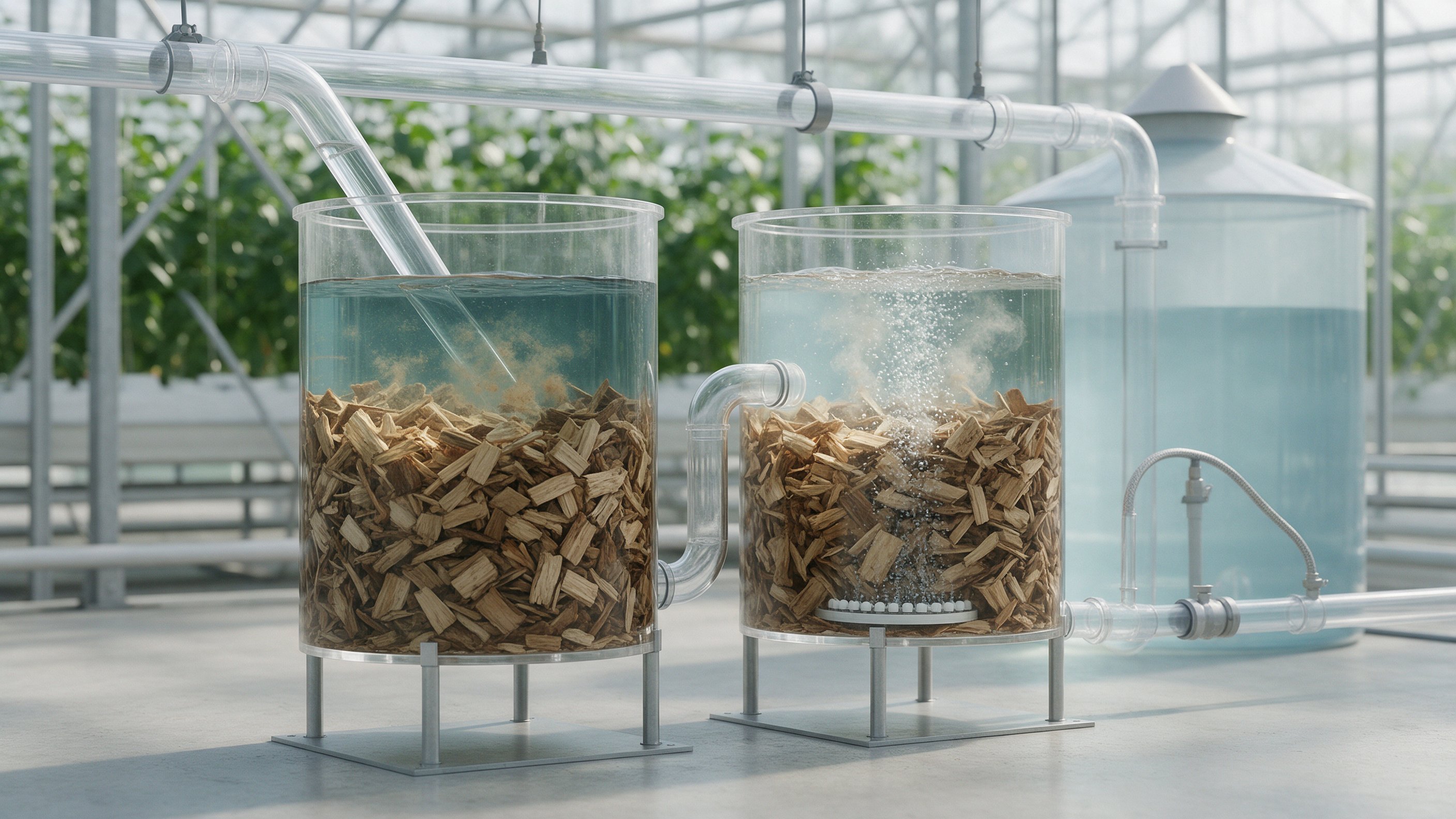
Michigan State University researchers are testing a simple treatment approach for greenhouse irrigation water: passing recycled runoff through woodchip bioreactors. Supported by the American Floral Endowment, the team led by Dr. Tom Fernandez is examining whether the systems can remove unwanted pesticides while retaining nutrients that growers want to keep, such as nitrogen, phosphorus, potassium and micronutrients.
Water recycling helps growers conserve water and improve efficiency, but it also creates a management problem. Runoff can carry fertilizers and crop protection products into storage tanks, where those materials may accumulate. The project aims to develop a treatment system that is practical, scalable and affordable for commercial greenhouse and nursery operations.
A woodchip bioreactor is essentially a tank or treatment area filled with woodchips through which water passes. The woodchips provide a surface for beneficial microorganisms to grow and a carbon source that supports microbial activity. They can also physically bind, or adsorb, some contaminants. Such systems have already been used in agriculture to remove nitrate from drainage water. Fernandez’s research has also shown that woodchip systems can remove phosphorus and pesticides when water remains in the bioreactor for a longer time.
For the greenhouse project, the researchers developed a two-stage system. Water first moves through a non-aerated woodchip bioreactor, where oxygen levels remain relatively low. It then enters a second bioreactor that is continuously aerated. The design is intended to take advantage of different microbial communities: some microorganisms thrive in low-oxygen conditions, while others perform better when oxygen is present. Some pesticides may break down more effectively under aerobic conditions, while others respond better to low-oxygen environments, according to the article.
The team installed bioreactors at a wholesale greenhouse in Michigan. The system treated return water from about 11,500 square meters of greenhouse production. Two differently sized systems were tested. In one, water remained in each treatment stage for about 30 minutes; in the larger system, it remained for about 60 minutes. Researchers collected water throughout the production season and analyzed it for nutrients, water-quality characteristics and hundreds of pesticides.
Early results indicate that the two-stage systems successfully created the different oxygen conditions the researchers were seeking. That allowed them to study how those environments affected nutrient recycling and pesticide treatment. The systems generally retained a high percentage of the nitrogen and phosphorus already present in the irrigation water. Nitrogen recycling often exceeded 80% and, under some conditions, averaged about 91%. Phosphorus recycling was also high in the initial non-aerated stage. The systems needed an initial acclimation period, but performance became more stable as the season progressed.
The project is still framed as research into a potential treatment option. The early findings reported here focus on the system’s ability to establish contrasting oxygen zones and retain nutrients. For growers, the researchers aim for a system that is practical, scalable and affordable, though the results also point to the need for acclimation and season-long performance monitoring.