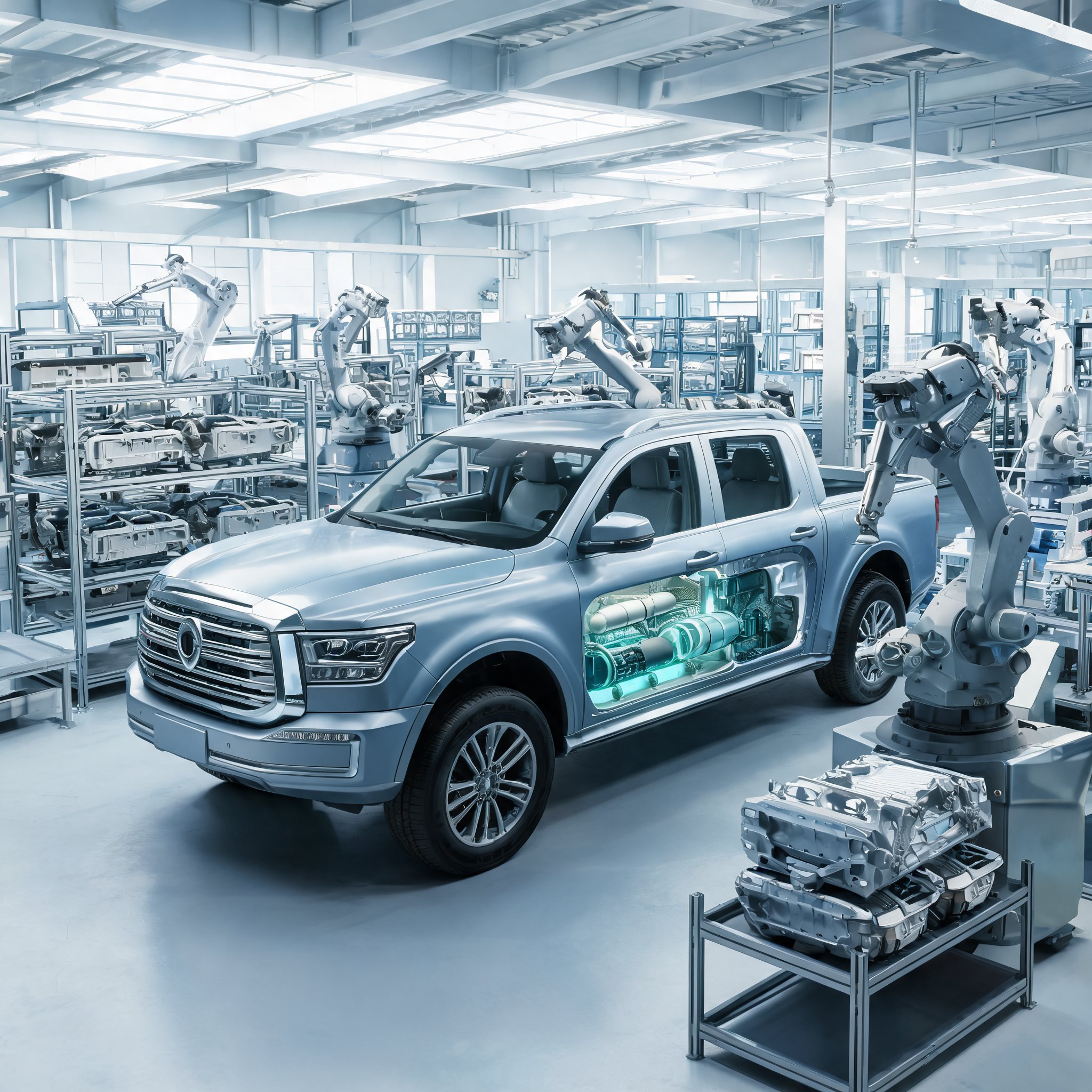
Thailand’s Board of Investment has approved a 1.49 billion baht (€39 million) investment by Toyota in its Ban Pho factory in Chachoengsao Province for production of the Hilux FCEV. The board said the vehicle would be the first hydrogen fuel-cell electric vehicle manufactured in Thailand.
Toyota is adding a dedicated production line at Ban Pho, where the ninth-generation Hilux is already built in internal-combustion, mild-hybrid and battery-electric forms. The hydrogen variant will therefore become the fourth powertrain built at the site, alongside those three existing Hilux versions. The company expects hydrogen fuel-cell output to begin in December 2027. It also plans an on-site hydrogen refuelling station to support production and testing of the vehicle.
Export-first niche model
Although Toyota launched the Hilux BEV in Thailand before offering it in other markets, the Hilux FCEV is initially planned only for export. European countries, Australia and New Zealand are the priority markets, according to the Board of Investment. Toyota intends to manufacture 3,000 units a year, a volume that frames the hydrogen derivative as a niche product rather than a mainstream replacement for diesel or battery-electric pickups.
At IAA Transportation 2026, Toyota showed the first teaser images of the Hilux FCEV. The images pointed to minor styling changes from other ninth-generation Hilux variants, including a daytime running light pattern with three separate segments along the upper edge of each headlamp and a closed upper grille area similar to the Hilux BEV. The show vehicle also appeared in a paint colour similar to the Force Blue offered on the Mirai.
Toyota is targeting a towing capacity of up to 2.5 tonnes and a driving range of more than 400 kilometres for the Hilux FCEV. The model is due to be launched in 2028. Before that, Toyota’s motorsport division, Gazoo Racing, is likely to test the underlying technology in a DKR GR FC Hilux in the Dakar Rally’s Future Mission 1000 category in 2027.
The rally version uses two fuel-cell stacks with a combined output of 400 kW and four high-pressure hydrogen tanks with a total storage capacity of 8.4 kg. Data from the Dakar programme could help Toyota refine the fuel-cell technology for the production Hilux FCEV. The Thai approval therefore covers more than an assembly line: it sets up a small-scale export programme and a local technical base for hydrogen fuel-cell pickups, while leaving the model dependent on a limited number of markets and a low planned volume.