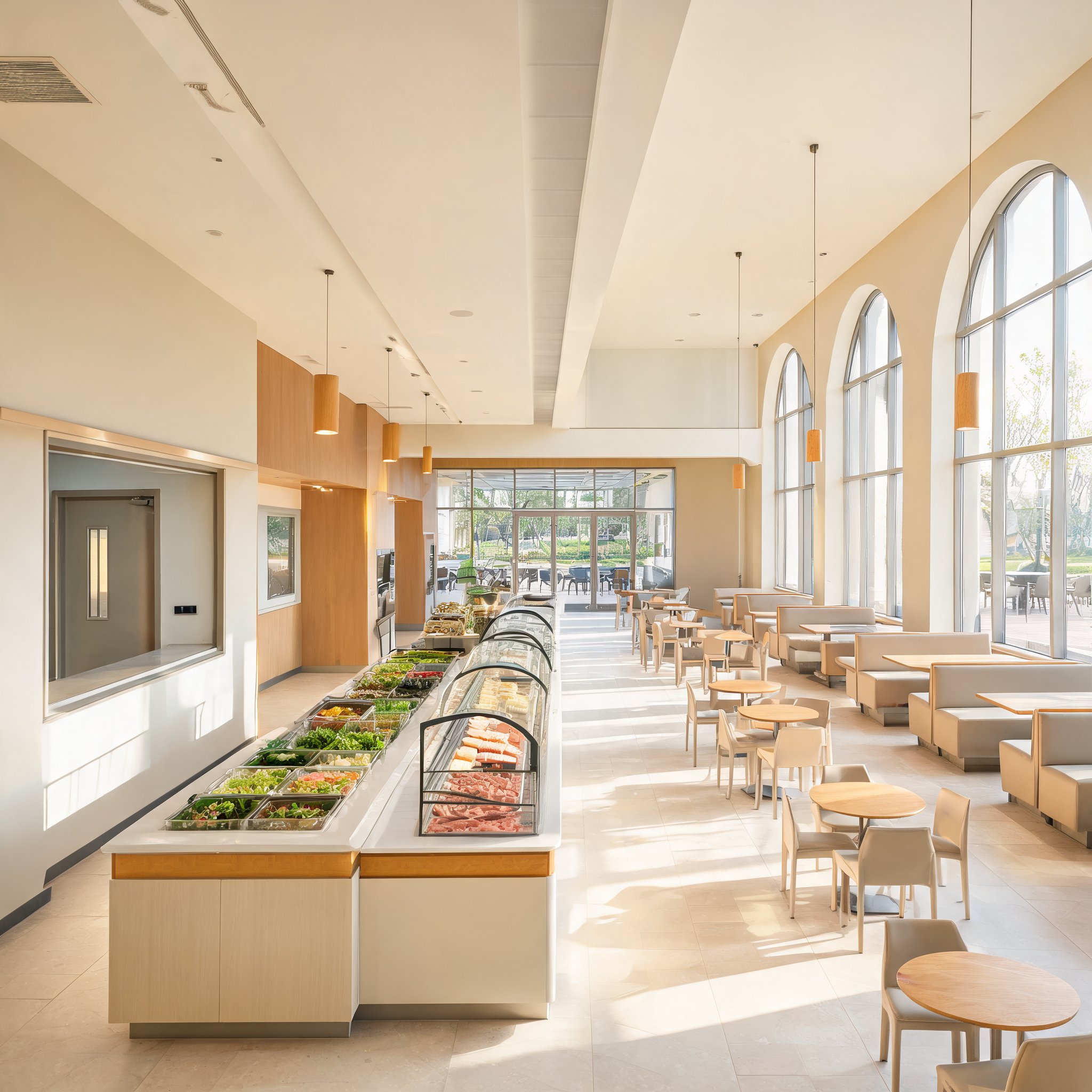
Texas Christian University has reopened its nearly 18-year-old Market Square dining facility as BLUU Dining, a 17,500-square-foot venue in the Brown-Lupton University Union that opened in August 2026. The project was part of a $17 million overhaul of the union and replaced a facility that students viewed as a self-serve cafeteria with premade food. The redesigned hall has 550 indoor seats, 120 patio seats and eight food platforms, including a to-go window.
The university’s in-house design team set two goals: create a destination dining spot for TCU students and increase meal-plan participation ahead of expected campus growth. Early results, according to the university, show a record number of guests. Less than two months after opening, BLUU Dining was averaging 4,000 meals per day, double the meal counts recorded when the facility closed for renovation in December 2025. Peak daily volume had reached about 5,700 meals, and Jude Kiah, associate vice chancellor for student affairs business and operations, said the operation could probably produce 8,000 meals per day if needed.
Research reshaped the brief
Planning began in 2022 with surveys and focus groups intended to measure satisfaction with Market Square. Kiah said the data showed that the facility, not the food, was the main source of dissatisfaction. Students also valued made-to-order food over speed of service and were willing to wait for customized meals. Kiah said the team conducted at least six surveys, including focus groups, before trusting that finding. He added that lines can stretch 20 people deep without discouraging students; when he timed a 15-person queue for bowls, the last customer was served in four minutes and 30 seconds.
Open spaces and a new to-go window
The design team removed walls and emphasized brighter, more open spaces. One of the biggest changes was moving the salad, deli and to-go platform away from the main servery to a wall of windows overlooking campus. Kiah said the area has become the most popular space in the facility because it is bright and offers a view of the stadium. The platform’s to-go window, called Dash, opens into the entrance hallway so time-pressed guests can pick up a premade sandwich or salad without entering the servery. Kiah described it as a way to add seats and options and potentially operate late into the evening with limited labor.
Back-of-house circulation also changed. Miles Oller, director of facilities and operations, said the previous servery’s narrow passageway was replaced with a wide service hall that has individual entrances to every platform, reducing competition for space. He described the improved ability to move product safely and efficiently as the renovation’s core operational gain. The support kitchen received epoxy flooring and a one-for-one replacement of nearly all of its roughly 15-year-old equipment. A new 800-square-foot walk-in cooler allows pallets to be rolled directly inside, unloaded onto carts and routed to their destinations.
Equipment chosen for throughput and upkeep
Planners selected equipment based on capacity, flexibility, maintenance needs and training requirements. A rotating pizza oven, for example, can produce 116 pizzas per hour and bake casserettes on its lower level; workers can load from the front and unload from the side without reaching into a 550-degree oven. Other favored pieces include a customer-facing soft-serve machine chosen for low amperage draw and simple operation, a round griddle that doubles as a plancha, and a pasta station that can pivot to breakfast.
In general, the team favored low-tech, durable equipment over computer-controlled units. Oller said the hardest units to replace were some 30-year-old oven ranges that had never broken down; the replacements came from the same supplier. Future maintenance also shaped choices, with the team avoiding a griddle brand and a warewasher brand that had posed repair difficulties. The university’s equipment service company researched parts prices for new equipment such as fryers to estimate long-term costs.
TCU opened East End, a dining hall on the opposite side of campus, in January 2025. The same group oversaw both projects, and the university has revamped menus with Sodexo’s One & All college dining program. Meal-plan enrollment stands at 6,300, with expectations of surpassing 8,000 in the coming year. Kiah said TCU plans to add 2,500 beds on campus next fall. The campus population is 13,500, including about 5,700 students living on campus.