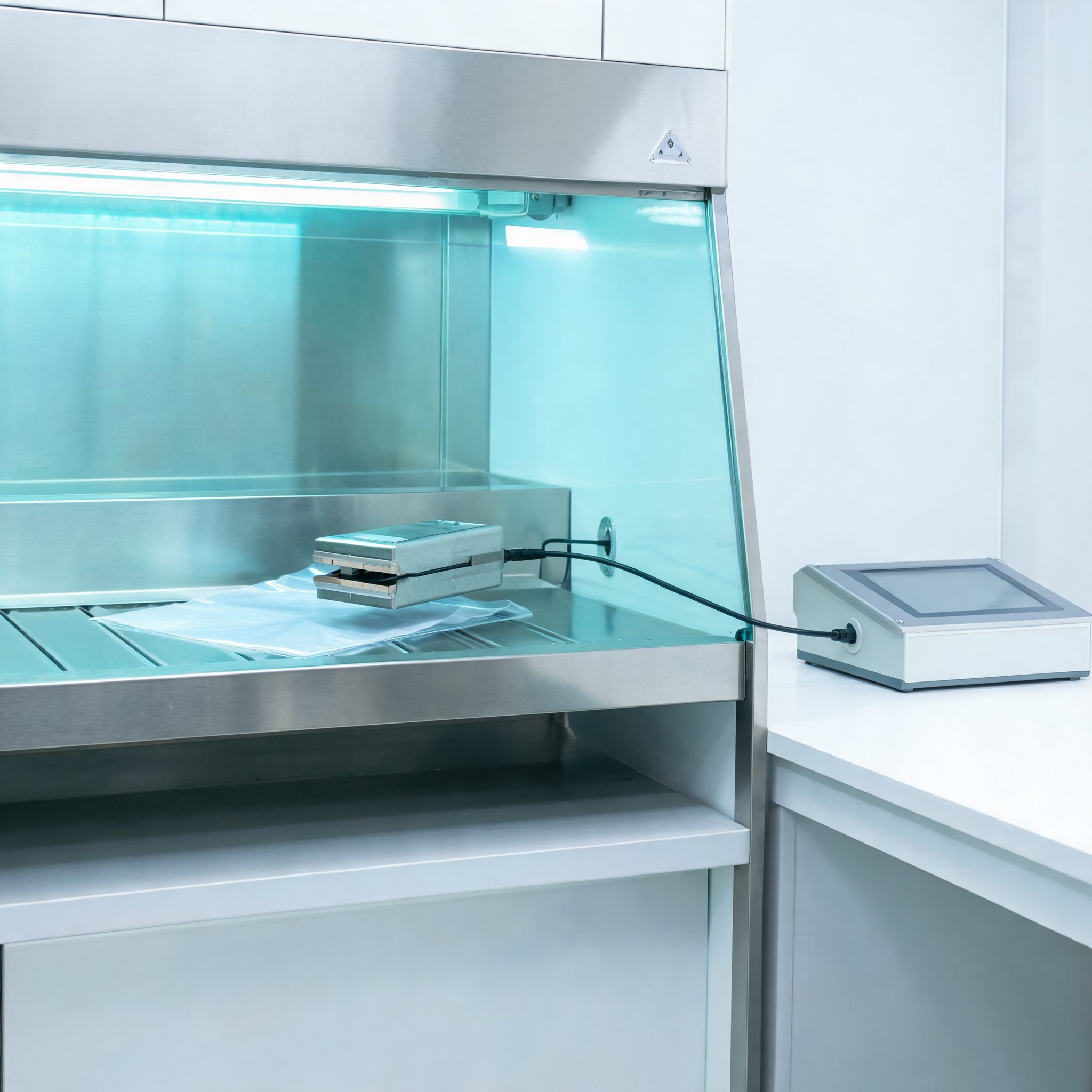
Packworld USA has announced the PW4214, a compact remote impulse heat-sealing system designed to produce repeatable, high-integrity seals in controlled environments used for tissue banking and regenerative medicine workflows.
The system is intended for biological safety cabinets and laminar flow hoods. According to Packworld USA, the small sealing head stays inside the critical clean zone, while the control module and touch-screen interface are located outside. The arrangement is meant to preserve workspace and support aseptic technique and process safety.
Designed for confined clean zones
Packworld USA says the lightweight remote sealing head can be integrated into existing containment equipment and fixtures, allowing technicians to seal flexible sterile barrier systems in confined spaces. A smaller machine footprint is intended to improve operator access and maneuverability when handling human tissues and other biological materials.
By keeping sealing-head controls outside the clean area, the design removes equipment bulk and electronics from the critical workspace. Packworld USA says this can help with airflow integrity and simplify wipe-down and sterilization protocols. Detachable seal bars are intended to make maintenance faster and easier, supporting maximum runtime.
Process control and compliance features
Standard features listed by the company include cleanroom-compliant construction; control of critical sealing parameters such as temperature, time and pressure; data logging to support 21 CFR Part 11 compliance; and a sealing zone suitable for flexible film of 13 inches or smaller.
Packworld USA states that its TOSS PIREG heat-sealing system can be used with the PW4214 to create hermetic heat seals across a range of films, including Tyvek, polyethylene, laminated foil, nylon and high-temperature specialty films such as FEP or PFA. The system is also described as ISO 11607 and RoHS compliant and includes TOSS Touch Screen control for managing critical sealing parameters and pursuing consistent seal quality from batch to batch and operator to operator.
Heat-sealing activity elsewhere in packaging
Other recent heat-sealing developments include Siegwerk’s May introduction of a heat-seal lacquer portfolio designed for consistent sealing, hot-tack performance and bond strength in fibre-based and selected flexible packaging applications. The lacquers are intended to deliver reliable sealing at different temperatures in fibre-based and certain flexible packaging solutions.
More recently, Zerocircle introduced a heat-sealable hydrophobic coating for paper cups made from natural polymers. The coating is said to provide water and grease resistance for hot beverages without a polyethylene lining or PFAS treatment, aiming to replace polyethylene lamination in conventional paper cups and the fluorochemical treatments used for water and grease resistance.
For Packworld USA, the PW4214’s focus is narrower: adapting impulse heat sealing to controlled biological workflows where the sealing head must remain inside a clean enclosure and the controls outside it.