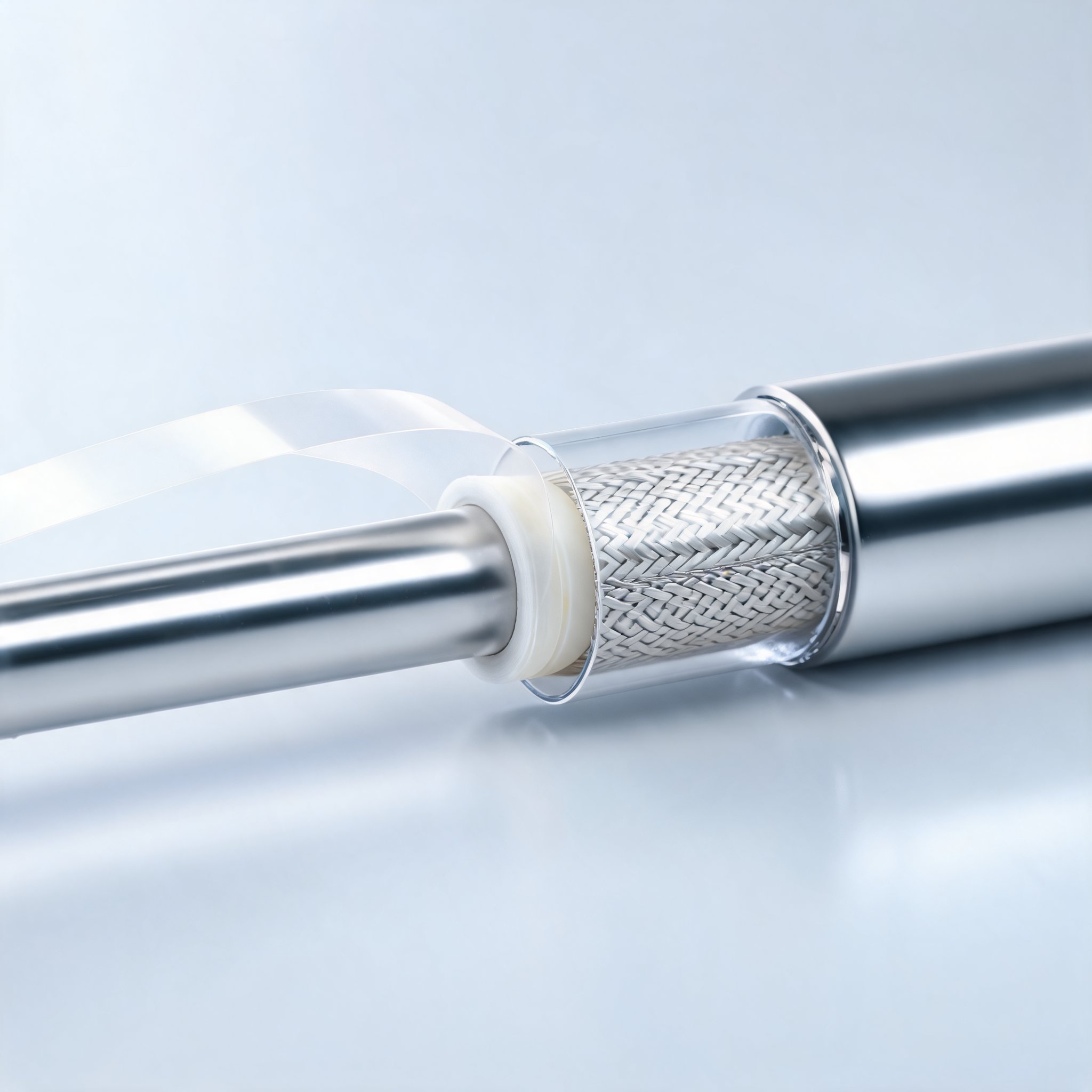
Junkosha announced a new catheter liner category, called Wrapped Liner, at MD&M Midwest in Minneapolis. The company says the category is based on its long experience in fluoropolymer technologies and applies proprietary PTFE tape engineering and wrapping to catheter liner construction.
Instead of extruding a complete tube, the process wraps PTFE film around a mandrel to build the liner wall. Junkosha says that engineering the tape properties allows the liner to be designed for a thin, uniform wall while maintaining high tensile strength and flexibility. The company presents the approach as an alternative platform for catheter designers and manufacturers.
A different construction route
The distinction is in how the liner wall is formed. Extruded and film-cast liners are already available with very thin walls, but Junkosha is positioning its wrapped construction as a way to change the balance between wall thickness and strength. According to the company, that balance can give designers more freedom to choose finer braid or coil wire or to use space elsewhere in the catheter.
Junkosha says the process is intended to produce a liner platform with thin, uniform wall thickness and exceptional strength. Those are company claims about design intent and performance, not independently verified clinical outcomes. The intended result is a construction option that may affect how reinforcement is configured in small-format catheters.
Design trade-offs in focus
Steve Maxson, founder of Maxson InSight Services, said catheter engineers often describe profile as king, but low-profile design involves more than reducing wall thickness. He said a catheter still has to resist kinking and ovalization while retaining the flexibility required by its application. With very thin extruded and film-cast liners already available, he said the opportunity lies in how thin-wall construction and strength work together to change design choices.
That framing places the new category within existing catheter design trade-offs rather than presenting thinness alone as the goal. Junkosha says the combination of thin, strong and more uniform properties is central to new catheter development because it may create more flexibility in reinforcement configuration.
Platform plans
Kevin LaDow, chief sales officer of Junkosha USA Inc., said current liners are generally either dip-coated PTFE built up on a mandrel or extruded PTFE supplied as cut-to-length tubing. He said that as the industry heads into 2027, there is a need for a liner category that is manufactured differently and offers benefits for small-format catheter OEMs.
Junkosha describes Wrapped Liner as a scalable platform intended to support a growing portfolio of solutions for evolving catheter requirements. The company says the approach extends design possibilities for next-generation devices intended to enhance flexibility and broaden the range of anatomies that may be accessed and treated. The company frames these as intended design goals rather than reported clinical outcomes.