Meisam Abdi, a researcher at De Montfort University Leicester, has received a 2026/27 Royal Academy of Engineering/Leverhulme Trust Research Fellowship. The award supports work examining whether additive manufacturing can produce artificial muscles for soft robots. Abdi is one of eight engineers in the UK to receive the fellowship, which funds up to a year of research into materials and structures intended to help robots move, sense and react in ways closer to biological systems.
Abdi said safe interaction between people and robots in places such as hospitals would require moving away from completely rigid structures. He argued that designers need to consider how robots can be given some of the attributes found in living systems.
Printed architectures rather than muscle replicas
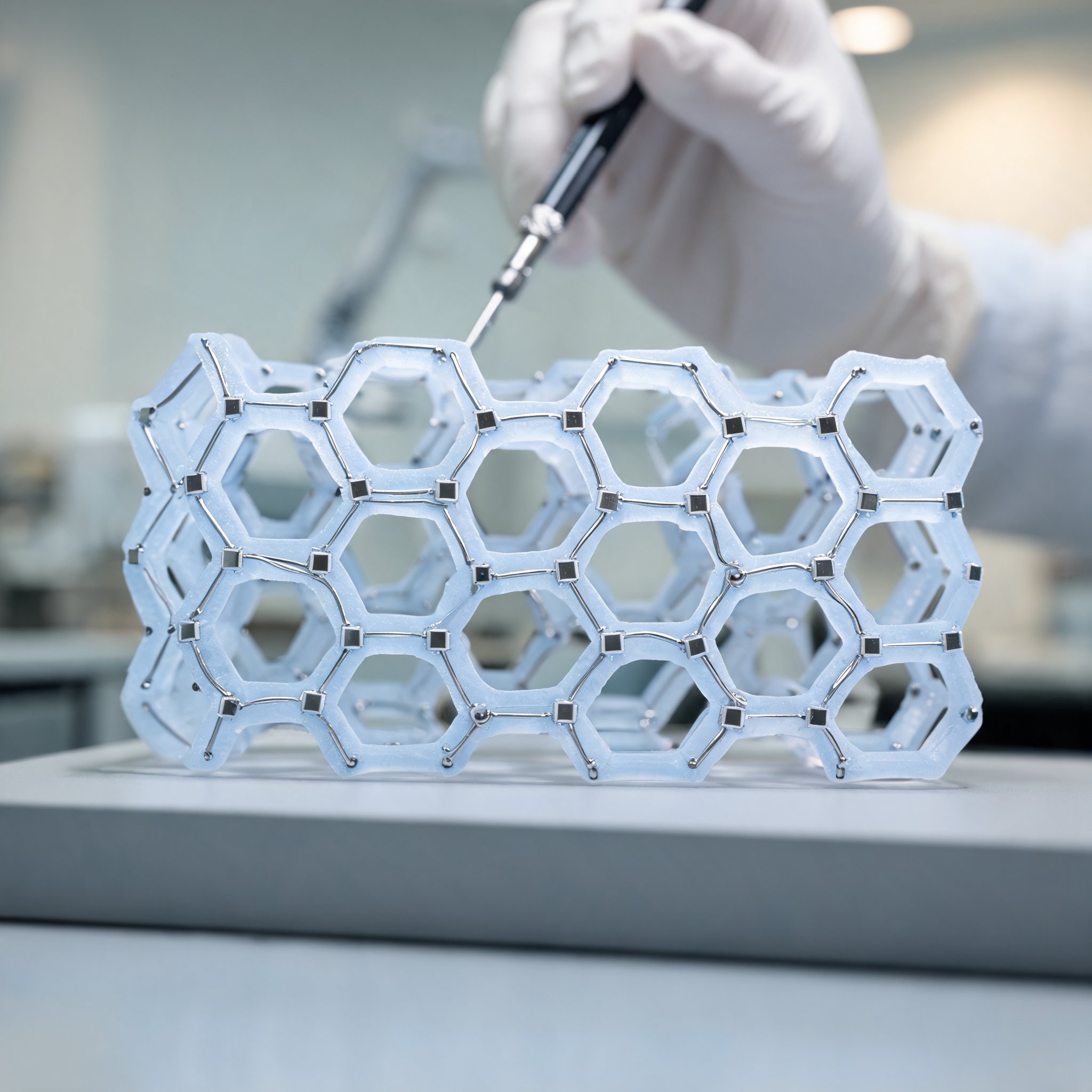
Rather than reproduce the physical structure of a human muscle, Abdi plans to use additive manufacturing to design architected structures whose geometry gives them specific properties. Different combinations of piezoelectric, conductive and structural materials and architectures are to be modeled with computer-aided engineering. The resulting designs are then to be 3D printed and tested in the laboratory for their response to electrical stimulation.
The longer-term aim is an artificial muscle that can produce movement, sense its environment and harvest small amounts of electrical energy from mechanical movement or vibration. The fellowship project is therefore directed at functions that are usually distributed across living systems, but it remains a research effort rather than a demonstrated product.
Piezoelectric materials and the lead problem
The project focuses on piezoelectric materials, which can convert mechanical deformation into electrical energy and deform when an electric field is applied. DMU said existing high-performance piezoelectric materials are often stiff and brittle, while some of the most widely used contain lead. Those characteristics complicate the development of artificial muscles that need to be soft, flexible and more sustainable.
Abdi's approach combines material composition with specially designed 3D printed cellular structures. The aim is to reach the required properties while keeping the structure soft and flexible. This is a materials-and-architecture strategy: the printed geometry is intended to contribute to the way the structure responds, alongside the choice of materials.
An ambitious prototype
Abdi described the project as ambitious. He noted that soft robotics already has a significant body of research, but creating something that can begin to replicate the multiple functions of living muscle remains a major challenge. His stated ambition during the fellowship is to develop a prototype that demonstrates what is possible and provides a foundation for further research.
He also framed the work as an attempt to move beyond copying structures that already exist in nature. By changing the materials and geometry of the artificial structures, the project will examine whether properties that do not currently exist naturally can be created. For soft robotics, the test will be whether a printed structure can combine movement, sensing and energy harvesting in a form that is flexible enough for closer human-robot interaction.