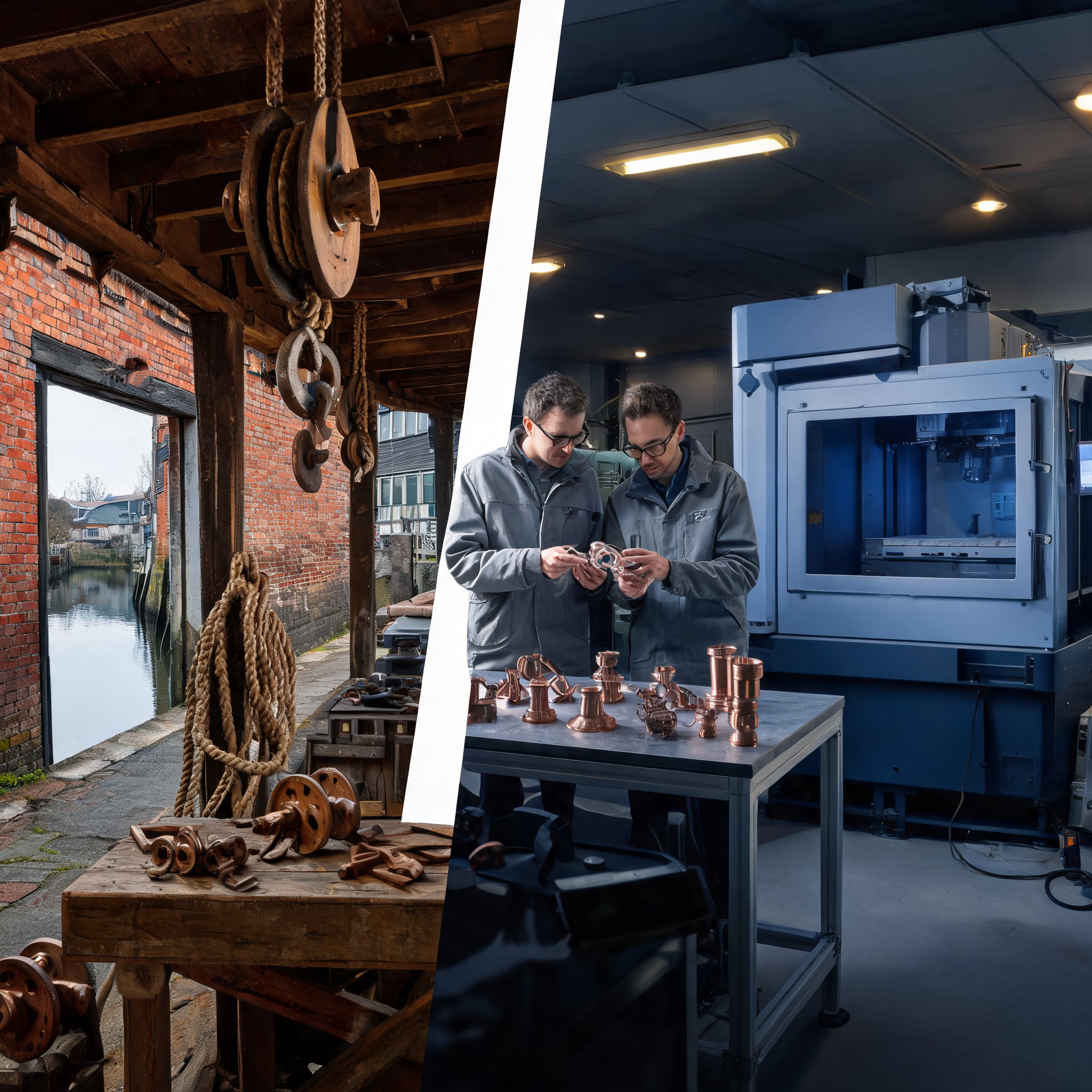
Britain enters Formnext 2026 with deep additive manufacturing research, a small machine-building base and a familiar question: can it turn invention into production? The UK is partner country at the Frankfurt fair from 17 to 20 November, where founders will be judged less on patents than on customers.
The historical contrast is Portsmouth’s block-making yard. In 1803, Marc Isambard Brunel’s machines, built by Henry Maudslay, began making wooden pulley blocks for the Royal Navy; by 1808, 45 machines produced 130,000. The Admiralty knew the sizes and quantities it used, watched the first machines work and ordered more. That was engineering plus an informed customer creating a demand signal.
Invention is not the bottleneck
British invention is visible. The European Patent Office counted 1,925 international additive patent families originating in the UK between 2001 and 2020, close to France’s 1,938. Additive Manufacturing UK’s 2026 plan put the UK market at £515m–£740m in 2024, or 3%–4.3% of the global total.
Neither figure shows where parts are made. Patent families record attempts to protect inventions; market estimates can include imported machines. Craig Pyser, AMUK chair and AMufacture chief executive, calls Britain’s share respectable for the economy’s size, while acknowledging the old complaint that British engineers invent what others sell.
Wayland Additive illustrates the gap. The Huddersfield company shipped a Calibur3 metal system to the University of Innsbruck in October for work on difficult materials, including high-temperature ones. Britain built and exported the machine; some knowledge of its use will accumulate in Austria. Will Richardson, the chief executive, points to metallurgy and materials science at Sheffield, Birmingham, Cambridge and Oxford as the research base.
Projects, not yet businesses
Funding can stop at the project. Jake Hand, co-founder of Exeter-based Rapid Fusion, says the large-format additive company is profitable without R&D support, but Innovate UK grants have helped it develop technology and share costs. He argues that funders back a project rather than a business. A grant pays for engineering time to solve a defined problem; it does not answer a customer’s questions about a specific mould, operator training or a mid-job stoppage. Those answers can take months for one sale.
Pyser describes innovation-funding applications as extremely difficult and wants assessors to visit companies that pass screening. Hand accepts that some bids are poor but says experience delivering one project should count. Kingston University offers one result: after a graduate joined Rapid Fusion, the company and his former department met, leading to a £450,000 Zeus robotic cell that combines large-format printing and CNC milling.
Equity and the first customer
University ownership can complicate the next step. John Robinson, additive manufacturing research commercialisation manager at Wolverhampton, incorporated a company in 2017 that funded his PhD and says he and the university filed several patent applications in 2024. Its former technology transfer office wanted 75% of the company; more recent discussions concerned a potential 10% stake. Both were proposals.
The national trend is toward smaller stakes. The Royal Academy of Engineering and Dealroom found that the average non-cash stake taken by universities in their sample of UK deep-tech hardware spin-outs fell from 25% in 2015–19 to 14% in 2024–25, though the 2025 data were partial. Robinson’s experience is one negotiation, but it shows why founders ask whether early ownership lets them raise money.
Customers remain scarce. Pyser says 95%–98% of AMufacture’s work is now production, with defence its largest sector. Some defence customers revise designs every six to eight weeks, so a local manufacturer able to take a revised file and deliver the next batch can earn repeat orders while the product changes. When one customer took production in-house, AMufacture helped install the printer, but the customer kept ordering; two years later it sold the machine to AMufacture after software, staff and post-processing proved more demanding than expected. The parts stayed in Britain, with a specialist spreading costs across accounts.
Orders create capability
Richardson points to Britain’s limited installed base and, in some markets, the shortage of major customers willing to put work through it. He says firms that do not perform production do not improve at it. A CNC machinist can learn to run an additive system, but regions with several factories can supply people who have already prepared builds and kept machines productive; with fewer installations, each firm trains more itself.
Renishaw’s Ben Deary and Ed Littlewood describe the problem of reshoring after years of buying abroad: a company can install a machine and hire operators only to find that a supplier once relied on for a component or service has gone. Apex Additive Technologies helps customers rebuild expertise by developing parameters and proving a process before production moves in-house. Qualification remains costly because evidence is specific to equipment, process and material grade. Jason Hutt of Fastech notes that casting is already approved. The £38m Airbus-led DECSAM programme aims to let suppliers learn major civil-aerospace requirements during development.
Procurement as demand policy
Policy attention often focuses on grants, but manufacturers return to procurement. James Selka, chief executive of the Manufacturing Technologies Association, told a House of Lords briefing that investment was poised to enter British manufacturing but needed a proper demand signal and co-investment from government. He put energy prices first among immediate obstacles. Lord Harrington, chair of Make UK, recalled that sector deals under Theresa May worked where companies could put substantial sums alongside public money; elsewhere, some firms government wanted to encourage could barely afford their share.
Harrington also described the financing problem from the other side. GeoPura, the hydrogen power business he chaired, tried to raise further capital in Britain and was sold to Canada’s Ballard Power Systems for £275m upfront in August.
In fusion, the UK Atomic Energy Authority commissioned two additive systems at its Central Support Facility in 2025: a Freemelt electron-beam machine for tungsten work and a Nikon SLM laser system supplied by Kingsbury Machine Tools with support from Additure. The order gave a British public institution access to equipment from international manufacturers. In separate maintenance projects, UKAEA reports that Laser Additive Solutions, The Welding Institute and WAAM3D contributed inspection and repair work. For a machine builder such as Wayland, the relevant question is when the next equipment specification will be drawn up; for a repair specialist, whether development leads to a maintenance contract.
UKAEA’s quarterly procurement pipeline helps suppliers distinguish possibilities over one to five years, pre-commercial work and confirmed requirements expected to go to tender. Even a confirmed tender is distant from a repeat order, but the distinction lets a small manufacturer decide whether to send an engineer, bid or make a case to its board. The Admiralty could specify block sizes before Brunel’s last machines were built. A supplier considering equipment for a future fusion plant faces a less certain timetable, which makes a public customer’s stated problems, evidence requirements and next purchasing decision more valuable than a general promise to support British industry.
Pyser has a simple test for Formnext. An overseas company looking for a European base and choosing Britain would count. So would a customer who saw a British-built machine in Frankfurt and ordered one, or a first installation that led to a second. A year after the fair, the more useful question for UK exhibitors will be who their next customer was.