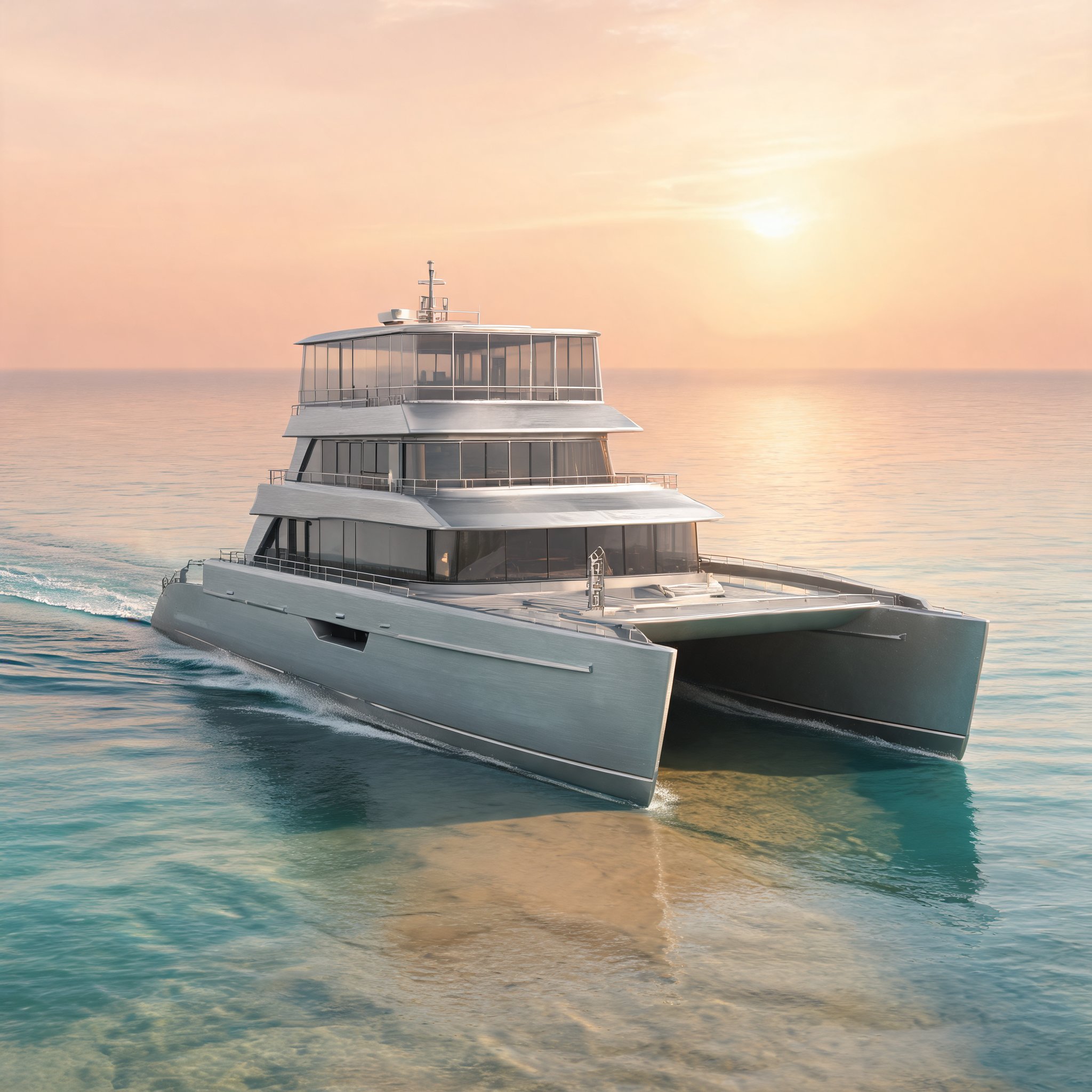
Bering Yachts has presented the first hull of its BC60, an 18.9-metre aluminium explorer catamaran that the yard positions as a long-range displacement vessel rather than a high-speed leisure multihull. The first hull has already been delivered and is afloat, and founder and chief executive Alexei Mikhailov gave a walkthrough of its design and onboard systems.
The BC60 measures 18.9 metres (60 feet) overall with an 8.6-metre beam and a draft of 1.58 metres. All-aluminium construction, the shallow draft and a fuel capacity of more than 13,500 litres are intended to support extended passages; Bering cites a range of over 3,500 nautical miles at a cruising speed of 8 knots. Fresh-water capacity is approximately three cubic metres, while the grey-water and black-water tanks hold 1,500 litres each.
Explorer principles on a twin-hull platform
Mikhailov said the design carries over what the yard proved on its B72 and B88 models, namely range, reliability, quiet running and the ability to stay self-sufficient for extended periods, and applies it to a catamaran. He described the result as a displacement exploration machine rather than a leisure cat.
Engine room, systems and structure
The unusually deep sponsons house a two-level engine-room arrangement, giving accessible space for generators, watermakers, sewage-treatment equipment and other machinery. According to Bering, the configuration also helps isolate noise and vibration from the living spaces. Protected running gear and attention to structural integrity are presented as part of a safety-oriented approach, and the aluminium construction and resulting weight distribution allow the BC60 to carry a fully enclosed flybridge that functions as a second salon.
Layout and accommodation
The main deck holds a salon with a full helm station offering 360-degree visibility, with a professional galley arranged on both sides of the space and equipped for practical use at sea.
One sponson contains the master cabin, which offers walk-around space beside the bed, panoramic windows, a walk-in wardrobe and an en-suite bathroom with a full shower. The opposite sponson holds two guest cabins, each with its own bathroom. A dedicated crew cabin, laundry and pantry areas, additional refrigeration and extensive storage run through the vessel, features intended to support long stays whether the catamaran is owner-operated or managed by a small professional crew.
The enclosed flybridge adds a bar, refrigeration, a day bathroom and 360-degree visibility, and can be configured as a lounge, gym or office.
Comfort and positioning
Bering treats onboard comfort as central to the expedition brief, citing low sound and vibration levels at cruising speed alongside the storage and systems sized for self-sufficiency. With its stated range, shallow draft and all-aluminium construction, the BC60 combines the practical requirements of a long-range explorer with the additional space a twin-hull platform provides, extending the design principles of the B72 and B88 to a new format.