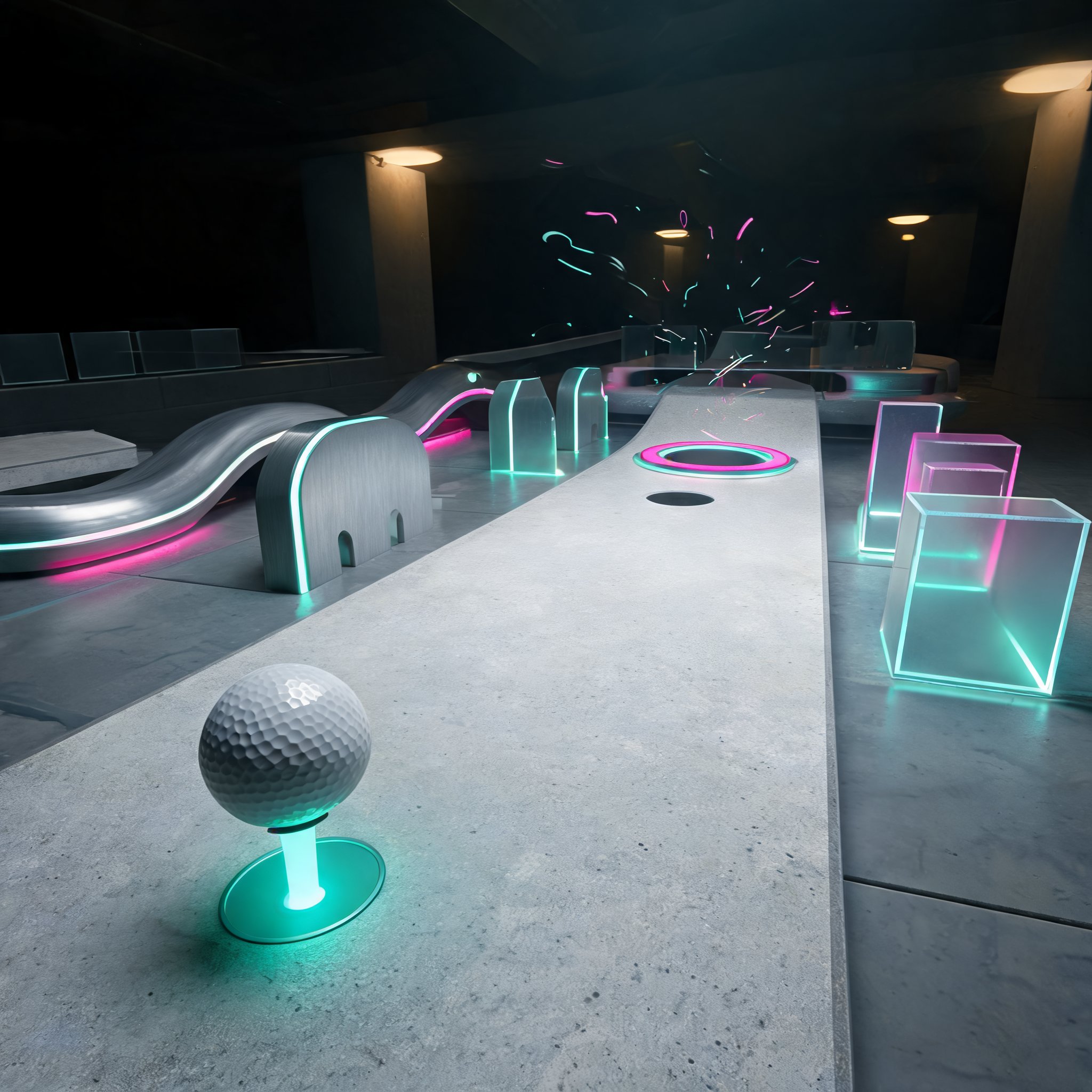
Holovis is repositioning its 360Golf brand from a technology-assisted putting game into what it calls a connected gaming platform for the competitive socialising market. The offer combines automated scoring hardware, a gamification layer and an analytics engine that gives operators data on how courses and players perform. The company is taking the system to IAAPA Expo in Orlando from 16 to 20 November and to the Land Leisure & Tourism Show at Birmingham's NEC on 4 and 5 November, where interested venues can also book a playable demonstration.
Familiarity as the differentiator
360Golf's pitch rests on an unusual argument for a technology product: mini golf does not need to be explained. Stuart Edgington, global director of business development, says the format is already one of the world's most accessible leisure activities, so the company builds on that base understanding rather than reinventing it. Players of any age register, collect an assigned smart ball and begin, which keeps instructions and staff time to a minimum.
That accessibility is aimed at operators who need an anchor attraction with intergenerational pull. Edgington argues the format can bring in families, young adults in competitive socialising groups and corporate bookings at the same time. Holovis says implementations now span the UK, Europe, the Middle East, North America and Asia Pacific.
Automation first, gamification second
The foundation is automated scoring. Smart balls, tees and cups work with the HoloTrac scoring system, which removes paper scorecards and acts as a referee when play is close. Layered on top is a suite of gamified features: SuperShots that offer alternative ways to score, Triumphs that present awards and unlock new challenges, plus bonuses, on-course games, player accounts, achievements, leaderboards and video celebrations.
Project manager Maaz Ussen describes the aim as sophisticated technology that feels effortless. Business development director Matt Dobbs frames the commercial logic: more reasons to compete, to celebrate and to compare scores at the end of a round become more reasons to come back.
DeepSmarts and the revenue case
Behind the player experience sits DeepSmarts, an AI analytics engine. Edgington says it supports higher uptime, insight into how players interact with courses, seasonality analysis and suggestions for operational tweaks, and can be sold as an additional service on top of the hardware. It also underpins remote support, because engineers can review course activity to diagnose faults a venue reports.
Holovis says the data has shaped a product intended to raise dwell time and secondary spend, with capacity designed for up to 80 players per hour per course. Dobbs argues that the self-service flow — kiosk, instructions, ball, play — frees operational staff to look after guests, food and drink, which he links directly to food-and-beverage revenue. Operators can also use the data to target quieter periods or under-served groups with promotions, and the company points to a robust, repairable hardware approach to extend lifespan.
Formats, timelines and custom work
Design flexibility is central to the model. At the simplest end, tech-only packages can be retrofitted into existing mini golf attractions; in the middle sits a catalogue of tried-and-tested holes; at the top is fully bespoke course development. Holovis quotes roughly six to eight weeks for tech-only installation, eight to 12 weeks for catalogue holes to be installed and ready to play, and upwards of six months for custom builds.
Recent work shows the range. At Butlin's PLAYXPERIENCE centre in Bognor Regis, a £15m project that opened in 2024, three nine-hole courses include a neon-glow layout, a Las Vegas-themed challenge and a wheelchair-accessible music-themed course. Dobbs says the venue has seen around 5,000 players and grossed roughly £40,000 in revenue in a busy week. For Norwegian Cruise Line, four installations under the Tee Time brand use marine-grade, IP-rated hardware, including rugged cups and tees and specialist screens, to deliver the same experience at sea. At Netflix House, the Top 9 course is a fully custom, IP-led build with holes themed around One Piece, Squid Game and Floor is Lava. Super Social in Leopardstown, Ireland, took 12 holes from a sports-themed package, while Lucky Duck in Norway offers two routes on every hole.
Ussen says physical design and technology are developed together, an approach that has extended into inclusive design: putters sized for tall guests, holes playable right- or left-handed, drop-down top caps so wheelchair users can reach or even get onto the course, and spacing between holes to reduce crowding and safety hazards.
Multi-site consistency and what comes next
For multi-site operators such as Saudi Entertainment Ventures, the shared technology provides a consistent base that can then be varied in theming, layout or branding, with sites networked together. Edgington says such clients are chasing repeat visitation, which the scoring and dynamic gameplay are meant to support. Smaller venues, he adds, can choose a more cost-effective, physically simpler course while keeping the same core system.
Holovis is also looking beyond golf. The team is working with Roxy Leisure to add stroke-counting technology to its crazy pool tables, and Ussen says the ambition is to apply the technology to other sports. Edgington expects competitive socialising eventually to reach peak saturation, and treats adjacent markets as the next opening.
For operators, the entry point is a conversation about the venue, its constraints and its audience — whether the target is Friday-night young adults, families or both — rather than a course purchase. Whether that turnkey framing holds will depend on delivery at scale, but low-friction play, measurable scoring and operational data are the core of the pitch.